The Xuanwu Panel Whitepaper
An online planting game in ink and paper: a rig that produces around the clock, a garden grown by real time, a market where harvests become goods, an arena where fed plants become a spirit beast's strength — and XWP, the game's points, flowing through them all.
Xuanwu Panel is an online planting game drawn like a newspaper and painted in Chinese ink. There is no steep learning curve: create an account with a passkey — Face ID is enough — and you are a trialist. Your personal rig produces XWP, the Panel's game points, around the clock; come back and claim it, then spend XWP on seeds in the Spirit Garden. Plants grow in real time and land in your satchel at harvest, where they can be pawned to the house or traded with other trialists at the Market — instantly in XWP, or against USDT buy orders through an escrowed flow. Garden harvests also feed your spirit beast at the fourth exhibit, the Beast Grounds, where it duels on a grid arena and climbs a guardian tower. XWP is the Panel's game points: it exists only inside the game, and carries no promise of price, yield or redemption value. This paper describes the exhibits, the game rules and how points and goods flow between them.
1 A Playground of Paper and Ink
The Panel is designed as a foreign-run newspaper printed with Chinese ink: rice-paper pages, serif headlines, indigo and vermilion, English by default with a one-tap Chinese switch, mobile first. Every rule is printed in the open — output formulas, unlock conditions, share ratios and trading fees all appear on the guide pages. No hidden doors.
Identity is a passkey. You register with Face ID or a fingerprint — no wallet app, no seed phrase — and the Panel issues you a trialist ID, a backup account key, and a Xuanwu Key: a real cryptographic key pair, generated for your account alone; exporting it asks for a fresh Face ID check. Passkeys sync through iCloud or Google, so a new phone simply works; lose everything, and your account key restores the account and lets you bind a fresh passkey. Fairness rests on one account per person: registration is invite-only (an invite code is simply the inviter's trialist ID; leave it blank and you join under the official account), each device may create just one account, and each account binds one passkey device. An email can be bound to the account for code-based sign-in; once bound it is locked and can never be changed. Accounts registered from the same environment — the same IP address, the same geolocation and the same device profile — are automatically flagged, and a confirmed flag bars the account from the Market.
2 The Exhibits
2.1 The Xuanwu Proving Ground — The Rig
Every trialist owns a rig. Start it and it completes one run every six hours — on server time, with the page closed, while you sleep. A Lv.1 rig produces 20 XWP per run; finished runs wait in storage until you claim them — just 1 at Lv.1–2 (the rig pauses, full, until you claim), 2 from Lv.3, 3 from Lv.6 and 4 at Lv.10. Claiming four rounds in a row (no gap over 36 hours) makes the next claim pay ×1.5 — the streak then resets and counts again. Upgrades spend XWP back into the game: the first upgrade costs 100 XWP and the ladder rises gently — 250, 450, 1,250 and beyond, 22,800 XWP in total to max out — while output climbs in small steps (25, 30, 50 … 100 per run) and then leaps at Lv.10 to 245 XWP per run.
Lineage is the Proving Ground's second engine. The trialists you invite form your transmission lineage: when they claim their runs, the spring shares with you — 8% from your direct transmissions, 3% from the second, 0.6% from the third — paid on top, never deducted from their output. Shares rest in a pending pool and unlock automatically once the source account is at least 24 hours old and has claimed three runs. Shares come only from rig output — garden harvests are never shared. Lineages also grow through tiers: 50 members make a Vanguard Squad, 100 a Xuanwu Legion, 500 a Xuanming Army, and at 1,000 the leader becomes a Team Captain with a physical reward.
2.2 The Spirit Garden — Grown by Real Time
The Garden shares the Proving Ground's wallet and points, with prices anchored at 1 USDT = 70 XWP. Buy a seed, sow it, and wait — plants grow in real time, even while you are offline, with the server as the only clock. Four strains form a ladder: Lingzhi (seed 10 XWP / grows 1 h), Snow Lotus (40 / 4 h), Dragon-Saliva Herb (150 / 12 h) and the Sacred Lotus (600 / 24 h). Harvesting a strain builds mastery — 80 Lingzhi harvests unlock the Snow Lotus, 120 Snow Lotus harvests unlock the Dragon-Saliva Herb, 160 of those unlock the Sacred Lotus. A harvest no longer pays XWP directly: the plants land in your satchel as goods (1 plant per plot per harvest, +1 under Moonlight Dew), to be pawned or traded (see 2.3).
Upgrading a plot is a growth surge: the higher the level, the faster plants grow — ×1.0 at Lv.1 up to ×2.0 at Lv.10, for 50 / 100 / 200 / 350 / 550 / 800 / 1,150 / 1,650 / 2,350 XWP — and upgrading mid-growth rescales the remaining time on the spot. Plots expand to at most 5 (200 / 800 / 2,400 / 7,600 XWP). Every harvested plant rolls for mutation at plot level ×0.2% (capped at 2%): a mutant becomes a glowing mutant treasure, pawned at five times the normal plant's floor. Each plot holds 5 energy: a harvest costs 1, and an empty plot grows at Lv.1 speed and mutation rate. Refill with a Spirit Spring (20 XWP) — or claim rig runs at the Proving Ground: every run claimed restores +1 energy to every plot. A rotating sky omen rules each round: Spirit Rain cuts growth time to ×0.9, Moonlight Dew has an 8% chance to add +1 plant to a harvest, and the Xuanwu's Breath makes harvesting cost no energy. Rare harvests trigger a Xuanwu Blessing paid in XWP: +30 from Dragon-Saliva Herb, +100 from the Sacred Lotus, +300 when a Sacred Lotus is harvested with all five plots at Lv.10.
2.3 The Xuanwu Market — Where Harvests Become Goods
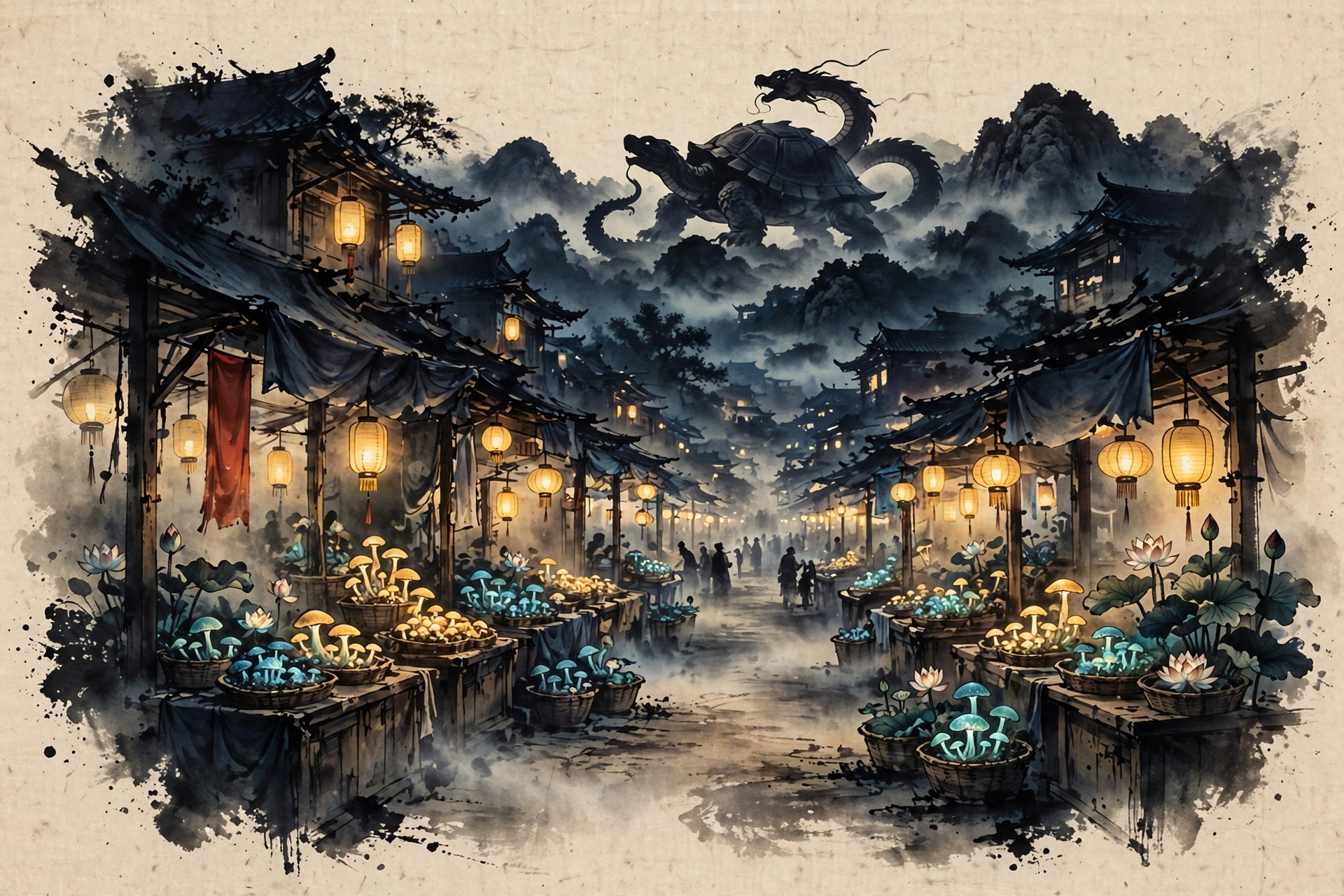
The Market is the third exhibit, sharing one account and wallet with the Garden and the Proving Ground. Everything you grow sits in your satchel — available, frozen in listings, or cooling down, each plant's state on one line — and there are three ways to turn plants into XWP. The simplest is the house pawn counter: 12 XWP per Lingzhi, 52 per Snow Lotus, 210 per Dragon-Saliva Herb, 880 per Sacred Lotus, mutants at five times the floor — instant, no duty. The second is XWP listings and buy orders between trialists: you set the price, trades settle instantly, and the seller pays a 5% stamp duty that is burned. An XWP buy order first sweeps the hall for listings at or below its price (cheapest first); whatever remains is escrowed as a standing order.
Payment-method rules: the Market registers USDT receiving — one BNB Chain (BEP20) address, changeable at any time.
USDT buy orders form a third rail. They are buy-only — there are no USDT listings — and they skip the 48-hour account-age gate and the volume caps. The 5% stamp duty and the buyer's 30% good-faith deposit still apply, converted at the platform rate of 1 USDT = 70 XWP; a seller may take a USDT order only with a USDT address registered, and plants bought with USDT carry the same 24-hour lock.
2.4 The Spirit Beast Grounds — Where Plants Become Strength
The fourth exhibit is an arena. Every trialist may claim one Xuanwu spirit beast for 10 XWP — the egg hatches on the spot — and the beast is fed from the same satchel the Garden fills: each plant gives growth (Lingzhi 1, Snow Lotus 4, Dragon-Saliva Herb 16, Sacred Lotus 64; a mutant treasure gives three times as much), affinity, and a focused nurture — Lingzhi builds HP, Snow Lotus speed, Dragon-Saliva attack, the Sacred Lotus a little of everything, each capped. Affinity evolves the beast: at 30 it becomes an Armored Spirit Beast, at 120 the True Xuanwu, each stage multiplying all stats. Feeding is unlimited, but the day's first six feeds can trigger Xuanwu's Guard — a blessing rolled before the feed and fixed for the day: ordinary plants can grant +5% to all duel stats for the day, a Sacred Lotus +15%, and mutant treasures double the odds.
Duels are turn-based on a 7×4 grid. Your beast has four skills — Shell Ram, Tide Breath, the Xuanwu Guard shield, and the Sea-Quelling Surge unlocked at the second stage — and faces wild beasts matched to its level. Ten battles a day each settle a random 1–5 growth, win or lose (the record keeps both), with higher rolls rarer; battle rewards are growth only, never XWP. A public power ranking lists the strongest beasts by their derived power.
Above the arena rises the Tower of the Dark Deep. A guardian beast — specced by the server, stronger every floor, a boss every tenth floor — holds each floor, and you climb one floor at a time: five attempts a day, separate from regular battles. Clearing a floor grants growth (bosses pay double) and the progress is permanent; the rankings carry a Tower tab recording how high every trialist has climbed.
3 XWP, the Panel's Game Points
XWP (XuanWu Power) is the Panel's game points: the Proving Ground produces it, the Garden spends it, the Market moves it between players, and transmission shares settle in it. Points live only inside the game — every movement is recorded to the unit in each trialist's own ledger, and points can be spent only on the game's own content: seeds, upgrades, plots and exhibits.
4 How Points Flow

- Production. The rig is the only faucet: at most 4 runs a day per trialist. A Lv.1 rig produces 80 XWP base per day; the Lv.10 ceiling is 245 per run, 980 per day. The streak bonus is a capped percentage. Transmission shares are additional emission and counted in the site-wide issued total; Xuanwu Blessings are small direct drops inside the Garden.
- Spending. A maxed rig burns 22,800 XWP over its lifetime; Garden seeds, growth-surge upgrades, plot expansion and Spirit Springs recycle XWP continuously; and the Market's 5% stamp duty on every player trade is destroyed — removed from the game.
- Synergy. Claiming restores garden energy; garden produce returns as XWP through the Market and funds rigs and seeds again. The four exhibits feed each other — harvests feed the spirit beasts, and activity on any side lifts the rest.
5 What Is Live
- Live now. The Xuanwu Proving Ground (passkey accounts, rig output, transmission shares), the Spirit Garden (real-time growth, mutant treasures), the Xuanwu Market (house pawn, instant XWP trade, escrowed USDT buy-order trade), the dynamic exhibit hub, the global asset bar, the on-site mailbox, and the Spirit Beast Grounds (claimable beasts, grid duels, the Tower of the Dark Deep).
6 Statement
XWP credits are the Panel's game points, and they carry no promise of price, yield or redemption value. The Garden and Market formulas in this paper describe how points and goods move inside a game — not investment returns. The Xuanwu Panel is an online planting game, and this document is its rulebook, not investment advice. The rules described here may change, and changes will be announced on the homepage first. Please confirm the rules on digital assets in your jurisdiction before participating.
This document is updated as the game evolves; the latest version always lives at mchain.art/whitepaper/. Exhibit guide pages and homepage announcements prevail where they differ.